

If your Poland plans run from Kraków’s medieval Old Town and Wawel Castle to the Baltic coast at Gdańsk, the salt mines at Wieliczka, or the trails of the Tatra mountains, the first question is the practical one: do you need a Schengen visa for Poland?
Poland is a full Schengen member, so most short trips follow the standard Schengen short-stay (Type C) rules, up to 90 days in any 180 days, and the same “main destination” logic used across the Schengen Area. Whether you need a Schengen visa for Poland comes down to your nationality, and not where you live.
Here’s a walkthrough on who needs a Poland Schengen visa, how UK-based applicants apply through the e-Konsulat portal and the Polish Embassy in London, the documents you need, the €90 fee, how long it takes, and the insurance rule that trips people up at the counter.
Do You Need a Schengen Visa for Poland?
You need a Schengen visa for Poland if your passport is from a country whose nationals must hold a short-stay visa to enter the Schengen Area. For people living in the UK, that covers most non-EU, non-British passport holders, the visa you need is the Uniform Schengen Visa, known as a Type C (short-stay) visa. It lets you spend up to 90 days in any 180 days across the whole Schengen Area for tourism, business, study of under three months, or visiting family and friends.
British passport holders do not need a Schengen visa for Poland. Stays of up to 90 days in any 180 days are visa-free, for tourism, business, transit or family visits, on your passport alone.
One change is on the way, from the last quarter of 2026, British citizens will need an ETIAS authorisation before travelling to Poland and the other countries in the scheme. ETIAS is not a visa; it is a quick online approval, expected to cost around €20 and last three years, much like the US ESTA. It is not live yet, so for now, your passport is all you need.
Your Passport Must Also Meet These Rules
-
Issued within the last 10 years
-
Valid for at least 3 months beyond the date you leave the Schengen Area
-
At least 2 blank pages for the visa
The 90/180 Rule
A short-stay visa allows up to 90 days inside any rolling 180-day period across the Schengen Area as a whole, not Poland alone. The days are counted across every Schengen country you enter, so keep track if you are combining Poland with other stops. The EU’s official short-stay calculator helps you check your remaining allowance.
What Type of visa do you apply for?
Most UK applicants need a short-stay Type C visa. The Schengen system recognises three formats:
-
Single-entry visa: one entry into the Schengen Area.
-
Multi-entry visa: several visits while the visa is valid.
-
Airport transit visa: passing through an international transit zone only, with no entry into Schengen territory.
First-time applicants are usually issued a single-entry visa; more on single versus multi-entry below.
Poland Schengen Visa Requirements
Bring the original and a photocopy of each document; the consulate returns the originals after checking. The exact list depends on your reason for travelling, so follow the official checklist that matches your trip. A Poland Schengen visa application from the UK typically needs:
-
Passport: valid for at least 3 months beyond your departure from the Schengen Area, issued within the last 10 years, with at least 2 blank pages.
-
Completed application form: filled in on e-Konsulat, printed and signed, with your full Poland accommodation address.
-
UK residence document: your BRP, eVisa or settled-status share code, valid for at least three months beyond your return. If your status outlasts your BRP, bring the supporting Home Office letter or eVisa printout.
-
Passport photograph: one recent colour photo, taken in the last six months, against a plain light background, no glasses.
-
Travel medical insurance: at least €30,000 of cover across the whole Schengen Area, including repatriation, for every day of your stay (more on this below).
-
Proof of travel: return flight reservations in your name; a reservation is enough at this stage, you do not need paid tickets.
-
Proof of accommodation: a hotel booking, or an invitation letter from your host with a copy of their ID and proof of address.
-
Proof of purpose: an itinerary, a business or conference invitation, or a family invitation, depending on why you are going.
-
Proof of funds: bank statements for the last three to six months, recent payslips, or an employer’s letter confirming your job and salary.
Anything not in Polish or English should come with a certified translation, and the consulate can ask for further documents at any point.
How to Apply for a Schengen Visa for Poland
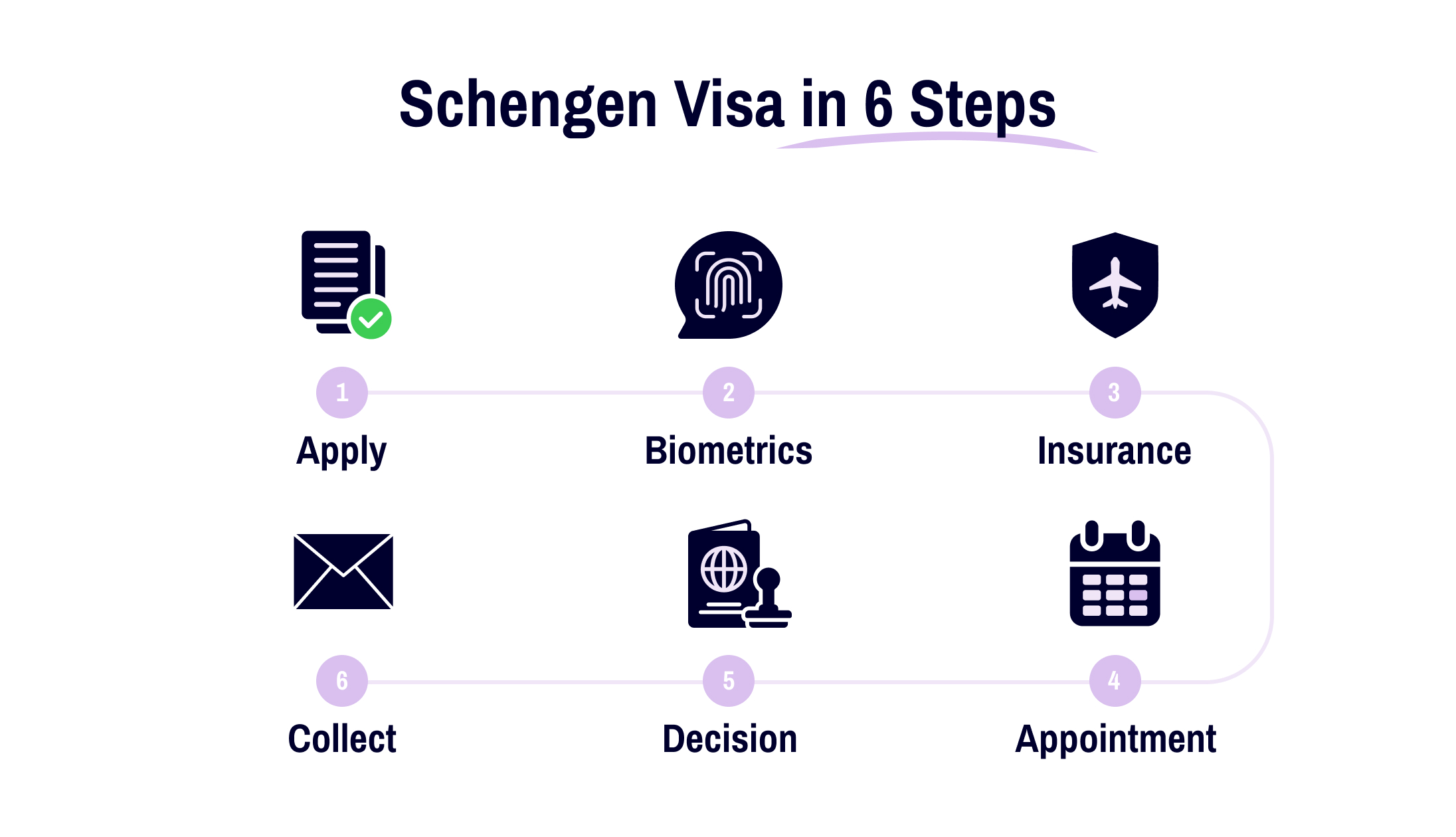
Poland handles UK applications differently from many Schengen countries. There is no VFS Global centre for Poland in Britain. Every application is registered online through the e-Konsulat portal and submitted in person at one office, the Consular Section of the Embassy of the Republic of Poland in London, at 10 Bouverie Street, EC4Y 8AX.
It is the only consular office in the UK allowed to issue Polish visas, so everyone applies in London. The process runs in six steps.
Step 1: Register on e-Konsulat and Choose the Right Purpose
Create an account on the e-Konsulat system and start a Schengen Type C application. When you book, you select a purpose-of-travel category: tourism and other, business, or visiting family and friends.
Step 2: Confirm Poland Is Your Main Destination
Apply through Poland only if it is where you will spend the most nights, or your first point of entry if your nights are split evenly.
Note: Applying through Poland when France or Spain is genuinely your main stop is one of the most common reasons UK applications are refused.
Step 3: Complete and Save Your Application
Fill in your details on e-Konsulat, making sure every entry matches your documents exactly. You will get an email asking you to confirm the application within 48 hours, then to finish the full form within a further 48 hours.
Step 4: Book Your London Appointment
Appointment slots for the London consulate are released through e-Konsulat every Sunday at 11:00. They go quickly, especially in spring and summer. If nothing is available, new dates appear the following Sunday as cancellations free up.
Step 5: Attend in Person and Give Biometrics
Bring your full document set. Staff check your file, take the visa fee, and record your biometrics, fingerprints and a digital photograph, for the Visa Information System. If you have given biometrics for a Schengen visa in the last five years, you may not need to attend in person.
Step 6: Collect Your Decision
You can track your application and collect your passport once a decision is made. A single-entry visa is the usual outcome for first-time applicants.
Poland Schengen Visa Fees
The Poland Schengen visa fee is €90 for adults, the standard rate across every Schengen country. It rose from €80 to €90 on 11 June 2024 and has not changed since.
-
Adult (12 and over): €90
-
Child aged 6 to 11: €45
-
Child under 6: Free
The fee is paid at your appointment and is non-refundable, even if your application is refused. Because you apply directly at the consulate rather than through a paid visa centre, there is no separate handling fee on top, a small saving over countries that route applications through VFS Global. Family members of EU, EEA or Swiss citizens exercising free-movement rights may be exempt.
Where to Apply and How Long It Takes
Every UK application goes through the Consular Section of the Polish Embassy in London, registered on e-Konsulat, and submitted in person at 10 Bouverie Street. There is no regional alternative, so applicants from across Britain travel to London to attend.
Processing Time
A Polish Schengen visa is usually decided within 15 calendar days of submission. In busy periods, or if the consulate needs extra checks, it can take up to 45 calendar days under the Schengen Visa Code. That is uncommon, but worth planning around.
You can apply up to six months before you travel and no later than 15 working days before. In practice, aim for four to six weeks ahead, or six to eight weeks over summer or at Christmas, when appointment slots are hardest to get.
Travel Insurance for a Poland Schengen Visa
Your travel insurance is a legal entry condition, not just a supporting document. The consulate checks it, and an application without a compliant cover is refused before it reaches a visa officer.
Your Policy Must Cover All Four of These
-
At least €30,000 in emergency medical costs, including hospital treatment
-
Emergency repatriation, including repatriation of remains, the part that most basic UK policies leave out
-
The entire Schengen Area, not only Poland
-
Every day of your trip, with no gap on your return date
A standard UK domestic policy or a non-Schengen plan will not qualify. Gigasure’s Schengen Travel Insurance is built to the €30,000 minimum across the full Schengen Area and gives you written confirmation of cover, the document the consulate expects to see in your file.
If you are likely to make more than one trip to Europe this year, weigh single-trip cover against an Annual Multi-trip policy. Our guide to Single-trip versus Annual Travel Insurance explains which suits which traveller.
Upcoming Changes: ETIAS
If you travel to Poland visa-free on a British passport, the change to watch is ETIAS. From the last quarter of 2026, visa-exempt travellers will need an ETIAS authorisation before entering Poland and the rest of the scheme. It is not a visa; it is a short online approval, expected to cost around €20 and last three years. Timings have shifted before, so treat it as a coming-soon planning item rather than something to sort today. If you need a Schengen visa, ETIAS does not apply to you; your application follows the standard process above.
Common Reasons a Polish Schengen Visa Is Refused
Poland applies the same Schengen refusal rules as every member state. If you are refused, you will get the reasons in writing; you can ask the consulate to reconsider, and if that fails, appeal through the Polish administrative courts. A few patterns come up again for UK applications:
-
Wrong main destination: applying through Poland when you will spend more nights in another Schengen country.
-
The wrong purpose category: booking under tourism when you are visiting family, for example.
-
Insurance that falls short: below €30,000, not valid Schengen-wide, or expiring on your return date.
-
A UK residence document close to expiry: It should be valid for at least three months beyond your return.
-
Thin proof of funds: no payslips, no employer letter, or a balance that does not match your plans.
-
Weak ties to the UK: nothing to show you will return, such as a job, tenancy or family.
-
An inconsistent itinerary: flight dates that do not line up with your accommodation or invitation.
Single-Entry vs Multi-Entry Poland Schengen Visa
A single-entry visa lets you enter the Schengen Area once; a multi-entry visa lets you come and go during its validity. First-time applicants are usually issued a single-entry visa.
Multi-entry visas, valid from one to five years, are granted at the consulate’s discretion, normally to people with a clean record of respecting previous Schengen visas.
Essential Contacts for Your Poland Visa Journey
-
e-Konsulat: register your application and book your London appointment.
-
Polish Embassy London: the Consular Section that issues Polish visas in the UK.
-
European Commission: applying for a Schengen visa.
Your Top Questions About Poland
Do I need a Schengen visa for Poland if I have a UK visa?
Not necessarily, it depends on your nationality, not your UK visa. A UK work, student or family visa lets you live here lawfully, but if your passport is from a visa-required country, you still need a Schengen visa for Poland. British passport holders need no visa for stays of up to 90 days in any 180-day period.
How much is a Poland Schengen visa from the UK?
The adult fee is €90, the standard Schengen rate since 11 June 2024. Children aged 6 to 11 pay €45, and under-6s are free. Because you apply directly at the Polish Embassy in London rather than a paid visa centre, there is no separate handling fee on top. The fee is non-refundable.
Where do I apply for a Poland Schengen visa in the UK?
You register online through e-Konsulat and submit in person at the Consular Section of the Polish Embassy in London, at 10 Bouverie Street. It is the only office in the UK that issues Polish visas, so applicants from across Britain travel to London to attend.
Can I apply for a Poland Schengen visa through VFS Global in the UK?
No. Poland does not use VFS Global for visa applications in the UK. Some VFS pages cover Poland in other countries, such as India, which can be confusing. In Britain, you apply directly through e-Konsulat and the Polish Embassy in London.
What travel insurance do I need for a Poland Schengen visa?
Cover of at least €30,000 in medical expenses, valid across the whole Schengen Area, including emergency repatriation, for every day of your trip. A standard UK domestic policy will not qualify. The consulate checks this first and refuses applications without a compliant cover before they reach a visa officer.
Poland Awaits! Start Your Polish Adventure Today
Whether you are mapping a route through Kraków’s Old Town, a weekend on the Gdańsk waterfront, or a few days hiking in the Tatras, Poland gives you a lot of trip for the effort. The visa itself is manageable once you know the route.
Register on e-Konsulat, choose the right purpose category, file a complete document set with Poland as your genuine main destination, and book your London appointment early. Check your UK residence document is not close to expiry, and apply four to six weeks ahead, longer in peak season.
The one part you can settle today is your cover. You can arrange Schengen-compliant travel insurance with Gigasure in minutes, with written confirmation of the €30,000 medical cover the consulate needs to see, and move forward with the rest of your Poland application knowing that box is ticked.
Note: Information accurate as of June 2026. Visa rules, fees, document lists and appointment arrangements can change; always check the latest details with the Polish Embassy London (gov.pl) and the e-Konsulat portal before you apply.