


Planning a visit to explore Hungary? Budapest splits across the Danube into two distinct cities, Buda's hilltop castle quarter on one bank, Pest's grand boulevards and ruin bars on the other.
Push beyond the capital and you find thermal baths bubbling up through Eger's wine country, Lake Balaton stretching 77 kilometres through summer-house villages, and a language that belongs to no European family you've heard of.
If you live in the UK on a non-UK passport, getting there starts with a short-stay Schengen visa filed through VFS Global, and a travel insurance policy that meets the Schengen Area's €30,000 medical cover rule.
This guide walks you through every step: who needs the visa, where to apply in London, Manchester or Edinburgh, what documents you'll need, how long it takes, and how to avoid the refusal triggers that catch UK-based applicants out.
Who needs a Schengen visa for Hungary?
You need a Schengen visa for Hungary if your passport is from a country whose nationals are required to hold a Schengen short-stay visa to enter the Schengen Area. That includes most non-EU, non-UK passport holders living in the UK, Indian, Pakistani, Nigerian, South African, Bangladeshi, Filipino, Chinese, and Sri Lankan nationals among them.
If you hold a British passport, you don't need a visa for Hungary for stays of up to 90 days in any 180 days. The Schengen 90/180 rule applies to UK citizens since Brexit.
The Hungarian Embassy in London confirms British citizens don't need a Schengen visa for tourism, business, transit or family visits within that window.
Do UK residents need a Schengen visa for Hungary?
UK residence on its own doesn't exempt you from a Schengen visa. If your passport is from a visa-required country, you need a Schengen visa for Hungary regardless of how long you've lived in the UK or what immigration status you hold here.
What UK residence gives you is the right to apply through the United Kingdom rather than your country of origin. The Hungarian Embassy in London is explicit: if you're not a resident in the UK, you should normally apply for a Hungarian visa at the embassy or consulate in your country of residence.
Schengen visa for Hungary: quick-glance summary
Visa type
- C-type Schengen short-stay visa
Maximum stay
- 90 days in any 180-day period
Visa Fee
- Adult fee: €90
- Child fee (6 to 12): €45
- Child fee (under 6): Free
Standard processing
- 15 calendar days from date of application. This can extend to 30-45 days if additional documents or security checks are required.
Earliest you can apply
- 6 months before departure
Latest you can apply
- 15 working days before departure
Where to apply in the UK
- VFS Global - London, Manchester or Edinburgh
Insurance requirement
- Minimum €30,000 medical cover, valid across the Schengen Area
Passport validity
- At least 3 months beyond intended departure, issued within the last 10 years
How to apply for a Hungarian Schengen visa from the UK
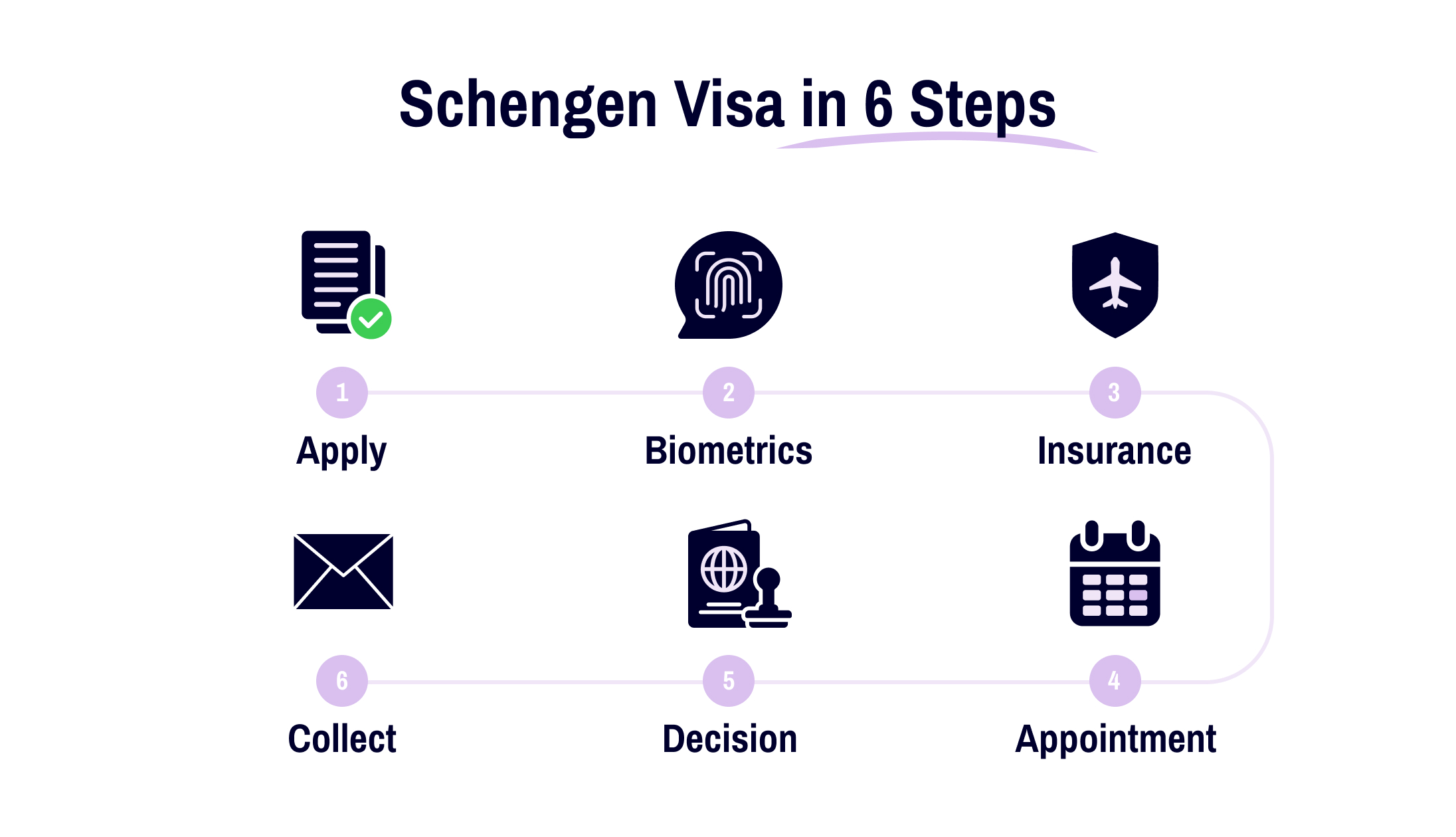
The application is filed through VFS Global, the Embassy of Hungary's official partner in the United Kingdom. The process runs in six steps, from checking eligibility to collecting your passport.
Step 1: Confirm you need a visa and pick the right country
Apply through Hungary only if Hungary is your main destination, defined under the Schengen Borders Code as the country where you'll spend the most nights. If your nights are split equally between two or more Schengen countries, apply through the country you enter first.
Note: Filing through Hungary when France or another Schengen country is genuinely your main destination is one of the most common refusal reasons for UK-based applicants.
Step 2: Gather your documents before you book an appointment
Pull together your full document set first. VFS Global will reject an incomplete file at the counter, and the Consulate can request additional evidence at any point. The complete checklist is in the next section.
Step 3: Complete the Schengen visa application form
Download and print the Schengen Visa Application Form. Fill it in clearly, sign it, and include your full accommodation address in Hungary.
If you’re travelling with a child, then both parents must sign. If only one parent is travelling with the child, bring a legalised authorisation letter and a copy of the non-travelling parent's ID.
Step 4: Book your VFS Global appointment
Schedule your slot through the VFS Global Hungary UK booking portal. Walk-ins are accepted at all three centres on working days between 08:30 and 11:00, but slots are limited. Pre-booking is faster and guarantees your place. You can submit up to six months before your departure date.
Step 5: Attend your appointment and give biometrics
Arrive at least 15 minutes early. At the centre, staff will:
- Check your document file
- Collect the visa fee
- Take your biometric data (fingerprints and a digital photograph) for the Visa Information System
- Forward your application to the Hungarian Consulate in London
If you apply in Manchester or Edinburgh, your file takes an additional three working days to reach the Consulate. Your appointment date stays the same, but the 15-day processing clock starts later.
Step 6: Track your application and collect your passport
You'll receive a reference number to track your application status online. Once a decision is reached, your passport is returned to the VFS centre where you applied, or to your home address if you've paid for the courier return service.
Documents Required for a Hungarian Schengen Visa
A Hungary Schengen visa application from the UK requires the following documents, based on the current VFS Global Hungary UK checklist and the Hungarian Embassy's published guidance. Bring originals and a photocopy of each; the centre returns the originals after checking.
1) Passport/travel document
Your passport must:
- have at least 2 blank pages
- be valid for at least 3 months beyond your intended departure from the Schengen Area
- have been issued within the last 10 years
2) UK residence permit
Your UK residence permit (BRP, eVisa, or EUSS status) must be valid for at least one month beyond your intended return date. If your status is under the EU Settlement Scheme, you'll need a share code generated through the GOV.UK "View and prove your immigration status" service.
3) Schengen visa application form
A completed and signed Schengen Visa Application Form, with your full accommodation address in Hungary included. For minors, both parents must sign, or a legalised authorisation letter and ID copy from the non-travelling parent must be provided if the child travels with one parent only.
4) Passport photograph
One recent passport-size colour photograph, taken within the last six months, against a plain white background, without glasses.
5) Travel medical insurance (mandatory)
Schengen-wide, the Visa Code sets a hard minimum. Your policy must:
- cover a minimum of €30,000 in medical expenses, including hospitalisation
- include emergency repatriation cover
- be valid across the entire Schengen Area, not just Hungary
- cover every day of your intended stay, including your return date
A generic UK domestic policy or a non-Schengen travel plan will not qualify. Applications submitted without compliant insurance are refused at the document check.
6) Proof of travel
Round-trip flight reservations showing your name and dates. You do not need to have paid for confirmed tickets at this stage; a reservation is sufficient.
7) Proof of accommodation
One of the following:
- confirmed hotel or hostel booking showing your name, dates, and address
- An invitation letter from your host, with a copy of their ID and proof of their address
- a tenancy agreement and landlord ID copy if you are staying in private rented accommodation
8) Proof of purpose of travel
Documents relevant to your reason for visiting, such as a travel itinerary, conference or business invitation letter, or a family invitation letter with the host's ID.
9) Proof of sufficient funds
- bank statements covering the last three to six months
- recent payslips
- An employment letter on company letterhead confirming your position and salary
10) Family or relationship documents
A family booklet or equivalent relationship documents are required if the purpose of your visit is to see relatives.
11) Previous Schengen visa history
Copies of any previous Schengen visas, if applicable. A clean Schengen travel record supports your application and may be relevant to multi-entry visa decisions.
Travel insurance for a Hungarian Schengen visa
Your travel insurance must cover at least €30,000 in medical expenses, be valid throughout the Schengen Area, and last for the full duration of your stay.
This is a hard legal requirement set under the Schengen Borders Code and applied uniformly by Hungary; an application without compliant insurance will be refused at the document check before it ever reaches the Consulate.
A compliant policy needs to cover:
- Emergency medical treatment and hospitalisation
- Emergency repatriation, including repatriation of remains
- The entire 29-country Schengen Area, not just Hungary
- Every day of your intended trip, with no coverage gap on your day of return
A general UK domestic policy or a non-Schengen travel insurance plan won't qualify. Gigasure's Schengen Travel Insurance is built to the €30,000 minimum across the full Schengen Area and gives you written confirmation of cover, the document VFS Global expects to see in your file. We'll come back to what to look for in a Schengen policy later.
Hungary Schengen visa fees
The Hungary Schengen visa fee is set at the European Commission level and applied by every Schengen country. As of 11 June 2024, the European Commission raised the adult fee from €80 to €90, and the child fee from €40 to €45, as published on the EU Commission Home Affairs page.
Visa Fee
- Adult (12 and over): €90
- Child aged 6 to under 12: €45
- Child under 6: Free
VFS Global also charges a separate service fee for handling your application and may charge for optional extras such as courier return or the Premium Lounge. The visa fee is non-refundable even if your application is refused.
Processing time for the Hungary Schengen Visa
A Hungarian Schengen visa is processed in 15 calendar days from the date your application reaches the Hungarian Consulate in London.
In peak season or for more complex cases, processing can extend to up to 45 calendar days under the Schengen Visa Code. This is uncommon, but it's worth knowing before you plan around a tight travel window.
If you apply in Manchester or Edinburgh, build in an extra three working days for your file to reach the Consulate. That doesn't change your appointment date; it shifts when the 15-day clock starts.
When to apply
You can submit your application no earlier than six months before your departure date and no later than 15 working days before.
In practice, apply at least four to six weeks ahead. If you're travelling in summer or over the Christmas period, when both appointment slots and Consulate workload peak, aim for six to eight weeks.
VFS Global Hungary visa centres in the UK
VFS Global runs three Hungarian Visa Application Centres in the UK. All are open Monday to Friday and accept walk-ins between 08:30 and 11:00 on working days.
London VFS Global centre
- Hungary Visa Application Centre: 66 Wilson Street, London EC2A 2BT.
- Submission hours: Monday to Friday, 08:30 to 17:30.
- The London centre is the busiest of the three and the only one with extended afternoon submission hours.
Manchester VFS Global centre
- Hungary Visa Application Centre: 50 Devonshire Street North, Manchester M12 6JH.
- Submission hours: Monday to Friday, 08:30 to 12:30.
Edinburgh VFS Global centre
- Hungary Visa Application Centre: 1 Rennie's Isle, Edinburgh, EH6 6QT.
- Submission hours: Monday to Friday, 08:30 to 12:30.
Common reasons for Hungary Schengen visa refusal
Hungary follows the same Schengen Visa Code refusal criteria as every other member state, but a few patterns recur for UK-based applications:
- Wrong main destination: Applying through Hungary when you'll spend more nights in another Schengen country is the single most common reason for refusal flagged in applicant forums.
- Insurance that doesn't meet the €30,000 cover rule: Doesn't extend to all Schengen countries, or leaves a gap on your day of return.
- UK residence permit too close to expiry: Your permit must be valid for at least one month beyond your return date.
- Insufficient proof of funds: A thin bank statement, no payslips, or no employment letter.
- Weak ties to the UK: No employment letter, no tenancy proof, no family ties demonstrated.
- Inconsistent itinerary: Flight reservations that don't match the dates on the accommodation booking or the invitation letter.
- Missing documents at submission: VFS won't refuse the application, but the Consulate will, and the fee is non-refundable.
- Unclear travel purpose: Vague or contradictory statements about why you're going.
If your visa is refused, you'll receive a written notification explaining the grounds and your right to appeal. Appeals are submitted to the Hungarian Consulate in London within 30 days of the refusal.
Single-entry vs multi-entry Hungary Schengen visa
A single-entry visa lets you enter the Schengen Area once. Once you leave, the visa is used. A multi-entry visa lets you enter, leave and re-enter multiple times within its validity period.
For most first-time applicants, the Consulate will issue a single-entry visa. Multi-entry visas, valid for one to five years, are granted at the Consulate's discretion, typically to applicants with a clean Schengen travel history and a consistent record of respecting previous visa conditions.
If you're planning multiple trips to Hungary or elsewhere in the Schengen Area within the same year, it's worth including a note in your application. There's no guarantee, but a strong travel history makes the case.
For more on choosing between single-trip and annual cover for your travels, see our guide to Single Trip vs Annual Travel Insurance. The same logic applies to how you plan your insurance around each trip type. If you're likely to make more than one Schengen visit in a year, Gigasure's Annual Multi-Trip Travel Insurance may also be worth considering alongside your visa decision.
Why Schengen-compliant travel insurance matters
Schengen Travel Insurance is a legal entry condition, not a supporting document. The Consulate checks it first; an application without a compliant cover is refused at the document check, before it reaches a visa officer.
Your policy must cover all four of these:
- €30,000 minimum medical cover: Set in the Schengen Borders Code. The Consulate checks the limit on your policy schedule directly. Anything below fails.
- The full Schengen Area: Not just Hungary. Your policy must be valid across all 29 Schengen states, even if Budapest is your only stop.
- Repatriation: Emergency medical evacuation and repatriation of remains. This is what most generic UK policies miss.
- Every day of your trip, including your return date: A policy that expires on the day you fly home leaves a gap. Make sure your end date aligns exactly.
Start Planning Your Trip Today as Hungary Awaits
You might be picturing a soak in the Széchenyi thermal baths, an evening in the ruin bars of District VII, a day trip to the basilica at Esztergom, or a slow drive through the wine country around Eger. Hungary earns the paperwork.
The visa itself is manageable. Apply through VFS Global, file a complete document set, use an honest itinerary that puts Hungary at the centre of your trip, and pair it with insurance that genuinely meets the €30,000 rule. Apply four to six weeks ahead, longer if you're going through Manchester or Edinburgh, or travelling in peak season. Check your UK residence permit isn't approaching expiry before you submit.
If you want to take one thing off your list today, you can arrange Schengen-compliant Travel Insurance with Gigasure in minutes and move forward with your Hungary application with that part confirmed.
Note: Information accurate as of May 2026. Always verify the latest visa rules, document checklists, fees, and UK submission arrangements with the VFS Global Hungary UK portal and the Hungarian Embassy London website before you apply.