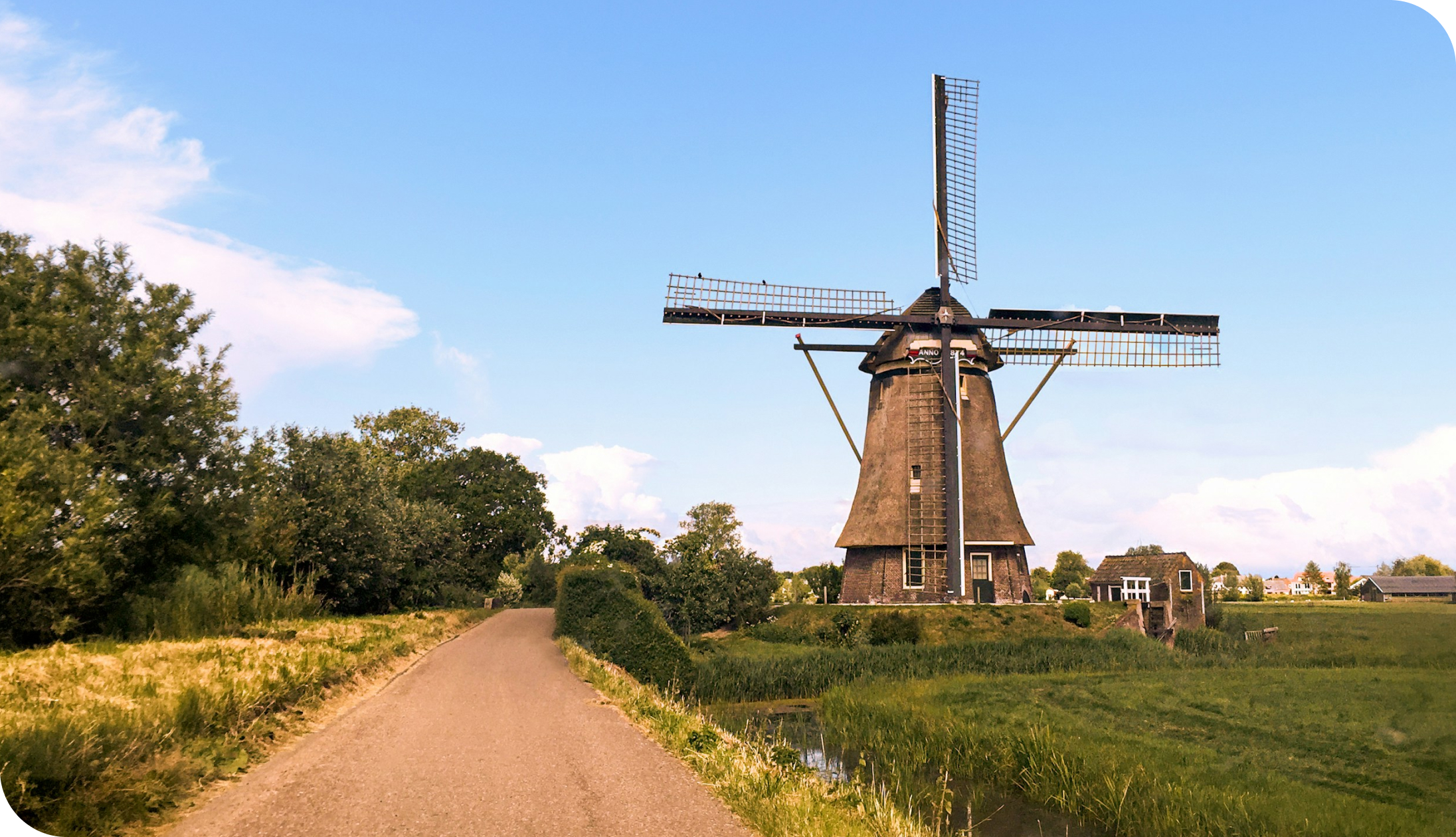


The Netherlands is one of Europe's most underrated road trip destinations. Inside an area smaller than Yorkshire and Lancashire combined, you'll move between sea-facing dunes, cathedral-quiet polders, the largest tulip fields on earth, and a UNESCO-listed feat of flood engineering, all on roads that are quiet, well-signed, and almost entirely toll-free.
For UK drivers, it's also unusually easy to reach: an overnight ferry crossing or a short Eurotunnel run plus a drive through Belgium puts you on Dutch tarmac without ever boarding a plane.
This guide covers everything you need to plan a self-drive holiday in the Netherlands, whether you're picking up a car hire at Amsterdam Schiphol or rolling off the ferry at Hook of Holland in your own vehicle.
A quick glance at a Netherlands road trip
Best time to go
- April - May (tulip season)
- June - August for long days and beach weather
- September - October (warm, quieter)
Minimum trip length
- 3 days for a Randstad-and-windmills loop
Recommended duration
- 5 - 7 days for a national highlights tour
Extended trip
- 10 - 14 days for the Netherlands, plus cross-border days into Belgium or Germany
Best starting points
- Amsterdam Schiphol
- Rotterdam (for ferry arrivals)
- Eindhoven
- Groningen
Driving side
- Right-hand side; overtake on the left
Speed limits
- 50 km/h in towns
- 80 km/h rural
- 100 km/h motorways daytime (06:00–19:00)
- Up to 130 km/h at night on signed sections
Tolls
- Almost none; just the Westerscheldetunnel and Kiltunnel
Currency
- Euro
Language
- English is widely spoken
Emergency number
- 112
Why the Netherlands is perfect for a road trip
Few European countries are as easy to drive in as the Netherlands. Distances are short, roads are excellent, signage is consistent, and the country's most distinctive landscapes sit close enough together to be linked in a single day's drive.
Compact geography, wide variety
You can have breakfast among the canal houses of Amsterdam, lunch at a polder café in North Holland, and dinner on a Wadden Sea harbour, all without driving more than three hours. The same compact geography means you can reroute on a whim; the next town is rarely more than 20 minutes away.
Roads built for drivers
Dutch roads are some of the best-maintained in Europe. Motorways are wide, junctions are clearly marked, and average-speed cameras keep traffic flow predictable. Outside the cities, you'll often have entire stretches of countryside road to yourself.
Places a coach or train can't reach
With a car, you can detour to a Frisian fortress village, park at a Wadden harbour and walk out at low tide, or string together half a dozen polder windmills in an afternoon. Public transport is good in the Netherlands, but it doesn't get you to the quiet places quickly.
Planning your Netherlands road trip
Best time to visit
- Spring (April - May): the headline season. Tulip fields are at peak from mid April to early May, Keukenhof (spring garden) is open, and temperatures are 12 - 18°C. Book accommodation near Lisse and the Bollenstreek months in advance.
- Summer (June - August): long daylight hours (sunset around 22:00 in June), warm weather, and beach-ready coastline from Zandvoort to Texel. Cities can be busy and accommodation pricier; Amsterdam parking becomes a sport.
- Autumn (September - October): the underrated window. Warm seas linger, the Veluwe forests turn copper, and crowds thin. Good for foodies, late summer harvests align with the cheese markets at Alkmaar and Gouda.
- Winter (November - March): short days and damp weather, but cities look beautiful with festive lighting in December. Rural roads stay clear and serious snow is rare. The trade-off is fewer hours of useful driving daylight.
Hiring a car in the Netherlands
Most travellers pick up their car at Amsterdam Schiphol, where every major rental brand has a desk in the arrivals hall. Eindhoven Airport, Rotterdam The Hague Airport, and the central railway stations of Amsterdam, Utrecht, and Rotterdam are also strong pick-up points if you want to skip Schiphol's queues.
The Dutch hire fleet skews towards manuals; automatics and EVs sell out fastest in summer, so book at least a month ahead in peak season.
If you're only driving outside the cities, a compact petrol or diesel car is the most economical choice. For city-heavy trips, an EV makes sense, charging is plentiful, and several Amsterdam zones now favour electric vehicles.
Documentation requirements for UK drivers
- A UK photocard driving licence is accepted; an International Driving Permit (IDP) is not legally required.
- A passport valid for at least three months beyond your planned departure date from the Schengen area.
- UK identifier required on your number plate or as a separate sticker (the old GB sticker is no longer valid).
- No motor insurance Green Card needed for UK-registered vehicles, though carrying your insurance certificate is sensible.
- The Schengen 90/180 rule applies where you can stay up to 90 days in any rolling 180 - day period without a visa.
- ETIAS pre-authorisation will be required for UK travellers once it launches; check the latest position before you book.
Choosing the right vehicle
- Compact petrol or diesel: the all-rounder. Easy on Dutch parking, efficient on motorways, no LEZ worries unless you pick a very old diesel.
- Automatic: worth the upcharge if you'll be in city traffic; book early in summer.
- Electric vehicle: excellent for the Netherlands. The country has more than 200,000 charging points, and most supermarkets, hotels, and motorway services have chargers.
- Estate or SUV: only worth it if you're travelling four-up with luggage; otherwise, it's surplus to requirements on Dutch roads.
Dutch road rules and driving tips
- Drive on the right; overtake on the left.
- The motorway speed limit is 100 km/h between 06:00 and 19:00. After 19:00, it can rise to 120 or 130 km/h on signed sections; always follow the gantry signs, which override the default.
- In built-up areas, the limit is 50 km/h; many residential streets and school zones are 30 km/h.
- Outside built-up areas, the standard rural limit is 80 km/h. Some quieter routes are 60 km/h.
- The blood-alcohol limit is 0.05% (0.02% for drivers with less than five years' experience).
- Handheld phone use is illegal. Use a hands-free system.
- Headlights aren't compulsory in daylight, but daytime running lights are recommended.
- Cyclists almost always have the right of way at junctions in towns. Look twice before turning right across a bike lane; this is the single biggest cause of foreign-driver collisions.
- Trams have priority over cars. Yield at every tram crossing.
- The European emergency number is 112.
Navigation, parking apps, and tolls
Google Maps and Waze both work well in the Netherlands; Flitsmeister is the Dutch-built option that adds live speed-camera and average-speed-zone alerts. Download offline maps for any rural areas where the signal is patchy, particularly the Wadden coast and parts of Drenthe.
Parking in Dutch cities is almost entirely cashless. Three apps cover most of the country: Parkmobile, Yellowbrick, and EasyPark. You set up an account before you travel, enter your hire car's number plate, and start a session when you park.
The most common foreign driver mistake is paying at a meter and then forgetting that the registered plate must match the car you're in. If you switch cars mid-trip, update the app.
Tolls are almost non-existent. The two exceptions are the Westerscheldetunnel in Zeeland (around €5 for a car) and the Kiltunnel near Dordrecht (around €2.40). Both can be paid by card at the booth.
Netherlands road trip cost breakdown for 7 days
Car hire (7 days, compact)
- £180 - £380
- €210 - €440
Fuel (around 1,000 km)
- £90 - £140
- €105 - €165
Tolls
- £3 - £8
- €3 - €10 (only if you cross Zeeland)
Car Hire Excess Insurance
- £25 - £55
- €30 - €65 (7 days, independent insurer)
Accommodation (per night)
- £70 - £180
- €80 - €210 (higher in Amsterdam)
Food and dining
- £35 - £70
- €40 - €80 per day
Parking (per day in cities)
- £15 - £40
- €18 - €48
Major attraction entry
- £15 - £25
- €18 - €28 (Keukenhof, museums, Hoge Veluwe)
Best Netherlands road trip routes
These seven routes cover the country's most distinctive landscapes and are designed to mix and match. Each one works as a standalone day or weekend; the itineraries that follow show how to string several together.
Route 1: The Afsluitdijk and IJsselmeer Loop
- Distance: 250-300 km / 155-186 miles loop
- Driving time: around 4 hours of driving; best enjoyed over 1–2 days
- Start / End: Amsterdam (return loop)
- Highlights: Volendam, Marken, Hoorn, Enkhuizen, the Afsluitdijk causeway, Friesland's southwest coast
The Afsluitdijk is the most distinctive drive in the Netherlands. The 32 km causeway across the IJsselmeer was completed in 1932 and turned what was once the open Zuiderzee into the world's largest reclaimed lake. Crossing it, you have water on both sides, the wind pushing you sideways, and a horizon that runs uninterrupted to the sky.
Treat the loop as a fishing-village circuit with a piece of engineering theatre at the top. You'll move between former herring towns, polder farmland, and the Wadden coast, with traditional architecture (gabled houses, lift bridges, working harbours) the whole way.
Highlights
- Volendam: traditional fishing port with Saturday-night smoked-eel stalls and one of the most photographed harbour fronts in the country.
- Marken: a small island connected by a causeway. Park outside the village and walk in.
- Hoorn and Enkhuizen: beautifully preserved East India Company towns. The Zuiderzee Museum at Enkhuizen is worth a half day.
- Afsluitdijk Wadden Centre: stop at the Kornwerderzand monument midway across the causeway for the panoramic view and the small visitor centre.
- Stavoren and Hindeloopen: tiny harbour towns on the Friesland side, ideal for an overnight.
Route 2: The Tulip Route through the Bollenstreek
- Distance: 70 km / 43 miles linear
- Driving time: under 2 hours of driving; allow a full day with stops
- Start / End: Haarlem to Leiden via Lisse
- Best season: mid-March to mid-May, with peak bloom in mid-April
- Highlights: Keukenhof, Lisse bulb fields, Noordwijk dunes, Sassenheim, Leiden
The Bollenstreek ("bulb region") is the strip of sandy soil between Haarlem and Leiden where the Netherlands' commercial tulip, daffodil, and hyacinth growers cluster. Drive the local roads, not the motorway, and you'll move between fields striped in red, yellow, and pink, with the dunes of the North Sea coast a short westward turn away.
Keukenhof, in Lisse, is the headline. Eight million bulbs flower across a 32-hectare landscaped garden each spring. It's only open for around eight weeks a year, and tickets sell out in advance, so book before you travel.
Highlights
- Park-and-stroll the smaller fields signposted off the N208 between Hillegom and Sassenheim; these are working production fields, so observe the field-edge access rules.
- Add Noordwijk for white-sand dunes and a coastal lunch.
- Finish in Leiden, Rembrandt's birthplace, with one of the prettiest canal-ringed centres in the country.
- If you miss tulip season, the same route in mid-August to mid-October passes through dahlia fields on the same farms.
Route 3: The Hoge Veluwe National Park and Arnhem
- Distance: 130 km / 80 miles loop from Arnhem
- Driving time: 3-5 hours; best enjoyed over 1–2 days
- Start / End: Arnhem (loop)
- Highlights: Hoge Veluwe National Park, Kröller-Müller Museum, Otterlo, Apeldoorn, Het Loo Palace
The Veluwe surprises people who think the Netherlands is all polder and dyke. It's the country's largest area of forest and heathland, with red deer, wild boar, and one of Europe's most quietly impressive art collections at the Kröller-Müller Museum (Van Gogh, Mondrian, Picasso, set in a sculpture park).
The drive into the Hoge Veluwe is part of the experience. Park at the Otterlo or Hoenderloo entrance, swap the car for one of the park's free white bicycles, and explore the inner roads on two wheels, then collect the car for the wider loop.
Highlights
- Hoge Veluwe National Park: pay the entry fee at the gate; allow a half day at minimum.
- Kröller-Müller Museum: nearly 90 Van Goghs, including 'Café Terrace at Night.'
- Het Loo Palace, Apeldoorn: the former Dutch royal residence, with formal gardens that rival Versailles in scale if not in spectacle.
- Arnhem: the city most associated with Operation Market Garden in 1944. The John Frost Bridge and the Airborne Museum tell the story.
Route 4: The Zeeland Delta Works
- Distance: 310 km / 193 miles loop
- Driving time: around 5 hours; best enjoyed over 2 - 3 days
- Start / End: Rotterdam (return loop)
- Highlights: Brouwersdam (N57), Oosterscheldekering, Neeltje Jans, Westerschelde tunnel, Veere, Middelburg, Goes
The Delta Works are the largest flood-defence system on earth, 13 dams, locks, and storm-surge barriers built across the southern estuaries after the catastrophic North Sea Flood of 1953. Driving them is the closest most people get to a piece of working civil engineering at this scale.
The N57 across the Brouwersdam is the showpiece: a long, low coastal road with the North Sea on one side, the Grevelingen lake on the other, and surfboards and kite-buggies in the dunes most of the year. From there, the route loops south across the Oosterscheldekering, through the protected wetlands of Neeltje Jans, and into the medieval cores of Veere and Middelburg.
Highlights
- Brouwersdam (N57): pull over at the lay-bys; this is one of the most photogenic stretches of road in the country.
- Neeltje Jans visitor centre: explains how the storm-surge barrier works and includes a working model.
- Veere: a tiny former harbour town with a market square that looks unchanged since the 17th century.
- Westerscheldetunnel: the country's longest road tunnel and the only stretch of the loop with a toll (around €5).
- Goes: an underrated overnight base, with good restaurants and a pretty harbour basin.
Route 5: The Wadden Coast and Friesland
- Distance: 220 km / 137 miles route
- Driving time: around 4 hours; best enjoyed over 2–3 days
- Start / End: Leeuwarden to Groningen (linear)
- Highlights: Leeuwarden, the Frisian lakes, Holwerd ferry to Ameland, Lauwersmeer, Pieterburen, Groningen
The Wadden coast is the Netherlands' quietest landscape, a UNESCO-listed tidal sea rimmed by sea dykes, with five inhabited islands a short ferry hop offshore. Drive the coast, and you move between bird-rich nature reserves, working harbours, and Friesland's Frisian-speaking villages, where the language, signage, and culture shift noticeably from the rest of the country.
Highlights
- Leeuwarden: the Friesian capital. Stop at the Fries Museum and walk the canal centre.
- The six-castles route: a 89 km signposted Friesland circuit through Marsuum, Jelsum, and Veenklooster (perfect as an inland day from this main coastal route).
- Holwerd: ferry across to Ameland for a half-day on the dunes and beach. Drive your car onto the boat or leave it at Holwerd.
- Lauwersmeer National Park: open skies, marsh birds, and almost no traffic.
- Groningen: the lively northern city you didn't know about, with a young university crowd and excellent food.
Route 6: The Limburg Hills and Maastricht
- Distance: 150 km / 93 miles loop
- Driving time: around 3 hours; best enjoyed over 2 days
- Start / End: Maastricht (return loop)
- Highlights: Maastricht, Valkenburg, the Drielandenpunt, Vaals, the Mergelland Route
Limburg, in the southernmost wedge of the country, is the Netherlands you don't expect. The land actually rolls, modestly, by mountain-country standards, but enough to feel like a different place, and the food, language, and pace edge towards Belgium and Germany. Maastricht itself is one of the country's prettiest cities, with a riverside old town and a café culture that runs late.
The signposted Mergelland Route loops through the chalk-and-marl hills behind the city, taking in vineyards (yes, in the Netherlands), half-timbered villages, and the Drielandenpunt, the official meeting point of the Netherlands, Belgium, and Germany, marked by a low stone column.
Highlights
- Maastricht: a half-day minimum. Walk the Vrijthof, climb the Sint-Pietersberg, and lunch on the Bisschopsmolen waterwheel terrace.
- Valkenburg: castle ruins, marl caves, and a Christmas market that takes over the underground passages each December.
- Vaals and the Drielandenpunt: stand in three countries at once; views west extend across to Aachen.
Route 7: Cross-border to Belgium and Germany
- Distance: varies; typical day-loops 180 - 280 km
- Driving time: 2.5 - 4 hours of driving; best enjoyed as a one or two-day extension.
- Highlights: Antwerp, Brussels, Bruges, Aachen, Düsseldorf, Cologne, the Hoge Kempen National Park
The Netherlands' size becomes an advantage when you treat it as a launchpad. From Maastricht, Aachen is 30 minutes; from Eindhoven, Antwerp is just over an hour. A weekend extension into either neighbouring country is genuinely realistic.
Highlights
- Maastricht to Aachen: Old-town day, Charlemagne's cathedral, then back across the border for dinner.
- Eindhoven to Antwerp: Antwerp's Modernist architecture and the Rubens-era old town in a single day.
- Rotterdam to Bruges: Best as an overnight rather than a day trip.
- Arnhem nach Düsseldorf oder Köln: Easy weekend extension if you're already in the Veluwe.
Practical tips for driving in the Netherlands
1. Sharing the road with cyclists
Cyclists are the most important road users to plan around in the Netherlands. There are more bicycles than people, and dedicated cycle lanes (the red-asphalt strip alongside or beside most roads) are treated as a separate carriageway.
Right of way at most urban junctions sits with the cyclist; the right-turn-across-bike-lane manoeuvre is the most common foreign-driver mistake. Look twice, mirror first, then move.
2. Low Emission Zones (milieuzones)
Eleven Dutch cities operate Low Emission Zones for diesel vehicles, including Amsterdam, Rotterdam, Utrecht, Den Haag, Eindhoven, and Arnhem. The rules apply only to diesel cars and vans below specific Euro emission standards (typically Euro 4 or Euro 5, depending on the zone). Petrol and electric vehicles are unaffected.
Modern hire-fleet diesels almost always meet the standard, but if you're driving an older personal vehicle from the UK, check the zone signs at city entry. Fines for non-compliance run from €110 upwards and are camera-enforced.
Zero-emission zones (ZEZ), separate from Low Emission Zones, are expanding through 2026 and currently apply to commercial trucks and vans only, not passenger cars.
Parking in cities
Treat city parking as a planned cost, not a found-on-arrival problem. Amsterdam, Rotterdam, Utrecht, and The Hague are expensive (€5 - €7 per hour in the centre, often €30 - €50 a day). Cheaper options:
- Park-and-Ride (P+R) on the city edge: typically €1 - €8 a day, plus a discounted public-transport ticket included.
- Off-street car parks: clearly signed, easier than street parking for first-time visitors.
- Hotel garages: pre-book, especially in Amsterdam, where street availability is minimal.
Almost all Dutch parking is now plate-recognition cashless, paid via Parkmobile, Yellowbrick, or EasyPark. Set up an account before you travel.
Fuel and EV charging
Petrol (benzine) and diesel are widely available; expect to pay around €1.95 - €2.10 per litre for unleaded at motorway services and €1.85 - €1.95 in town. Most pumps accept contactless cards; some unmanned stations only accept Dutch bank cards, so keep a backup card and know your PIN.
EV drivers have one of Europe's best charging networks. Shell Recharge, Allego, Fastned, and EVgo all operate fast-charging hubs across the motorway network; most major supermarkets and hotels also have AC chargers.
A single roaming card or app (Plugsurfing, Shell Recharge) covers most networks.
Mountain roads (or the lack of them)
The Netherlands is famously flat. The only real elevation is in southern Limburg, where modest hills mean slightly slower drives but nothing technical. Crosswinds are the actual hazard, particularly on the Afsluitdijk, the Brouwersdam, and the open Wadden coast. Both hands on the wheel, and don't be surprised if you have to angle into the wind.
Why travel insurance is also essential for a Netherlands road trip
Car Hire Excess Insurance covers your vehicle. It does not cover everything else that can go wrong, a missed ferry, a cancelled trip, a lost suitcase, or a medical emergency on a Veluwe walking trail.
Travel Insurance covers the gaps: unexpected medical treatment, trip cancellation, lost or stolen belongings, and flight or ferry delays through Gigasure's GigaShield feature, which activates cover for delays of three hours or more.
With Gigasure, you can arrange both Car Hire Excess Europe and Travel Insurance in a single place, manage both policies through the Gigasure app, and travel knowing the practical risks are covered. Travel smart. Stay protected.
What does Gigasure Car Hire Excess Insurance cover?
With Gigasure, your Car Hire Excess Insurance policy typically includes:
- Excess protection up to £10,000 (bodywork, tyres, roof, windscreen, undercarriage; plus fire, vandalism, and theft).
- Misfuelling covers up to £2,000.
- Rental car key protection included.
- Cover for up to 9 named drivers.
- Annual multi-trip policies covering up to 65 days of continuous cover per rental agreement, useful if you're combining the Netherlands with Belgium and Germany.
Time to plan your Netherlands road trip
A Netherlands road trip is one of the easiest and most rewarding ways to see Europe by car. The country is compact, the roads are excellent, and the variety of tulips, dunes, polders, hills, harbours, and the Afsluitdij is far greater than first-time visitors expect.
If you're rolling off the Hull–Rotterdam ferry in your own car or picking up a hire car at Schiphol, the formula is the same: pick two or three of the routes above, book ahead in tulip season, get the parking apps set up before you leave, and protect your hire car with independent excess cover so a kerbed wheel doesn't end the trip on a sour note. Have a good journey.